

A 3D video made from a CT scan reveals how a baby mummy died
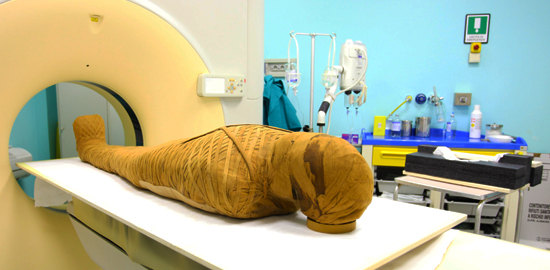
Tonight on Museum Secrets: Inside the ROM at 10 PM on History Television (Canada), one of the stories we explore takes us behind closed doors to investigate the mysterious death of a baby mummy. In order to discover what ended their short lives, Gayle Gibson from the ROM and Professor Andrew Nelson examine a CT scan of the tiny mummified boy.
Check out the trailer for a glimpse of what you’ll see in the episode and an exclusive 3D video taking you inside the baby mummy.
How was the 3D CT Scan video created?
Professor Nelson explains that CT scans are a series of individual slices through the body. Here, each slice is 0.6mm thick and each slice is composed of square pixels, where black represents air, white represents bone and gray represents soft tissue of different densities. Specialized software then stacks the individual slices and creates a 3D volume says Professor Nelson. “The operator then uses the software to separate different components for easier visualization, and then… joins them together to create the 3D image,” he explains.
[3D Video of baby mummy CT Scan created by Ngan Ngyen is a PhD Candidate in the Department of Anatomy and Cell Biology - not Anatomy and Physiology.]
According to Professor Nelson, the video tells us a few very important things about the baby.
“The body of the baby is very compressed, while the head is reasonably intact. That suggests that the body wasn’t compressed mechanically, or the skull would have been smashed flat too. The compression is probably due to the desiccation that is part of mummification.”
“The skeleton is fairly typical of a baby of this age, but babies of this age do not normally have a board thrust from their thorax into the base of their skull - nor do they have many of their thoracic vertebrae out of place. The rotation reveals the damage to the back and base of the skull, and the placement of the board between the shoulder blades where the thoracic spine should be.”
“The detailed analysis… shows the individual tooth buds, allowing us to estimate the age at death, at 9 months. It shows that the board probably displaced the bones of the base of the skull - thrusting them up into the cranial cavity.”